
Place Value Chart
Place value is the idea that a digit’s value depends on where it sits: the 4 in 4,000 is worth a thousand times the 4 in 4. Type any number and this place value chart puts each digit in its column from billions to thousandths, shows what each digit is worth, writes the number in expanded form and words, and rounds it to any place. A practice mode generates questions with answers.
- Free to use
- No sign-up
- Runs in your browser
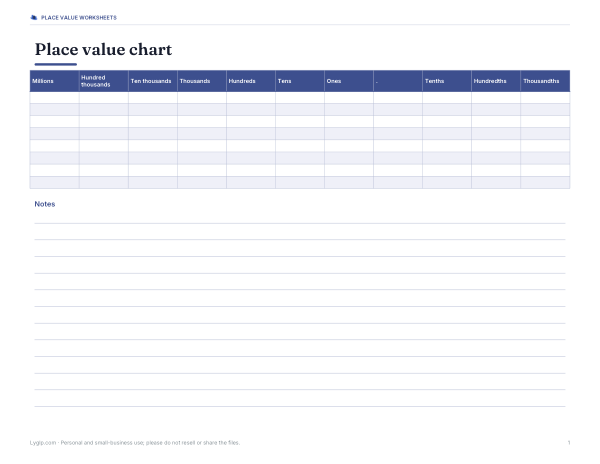
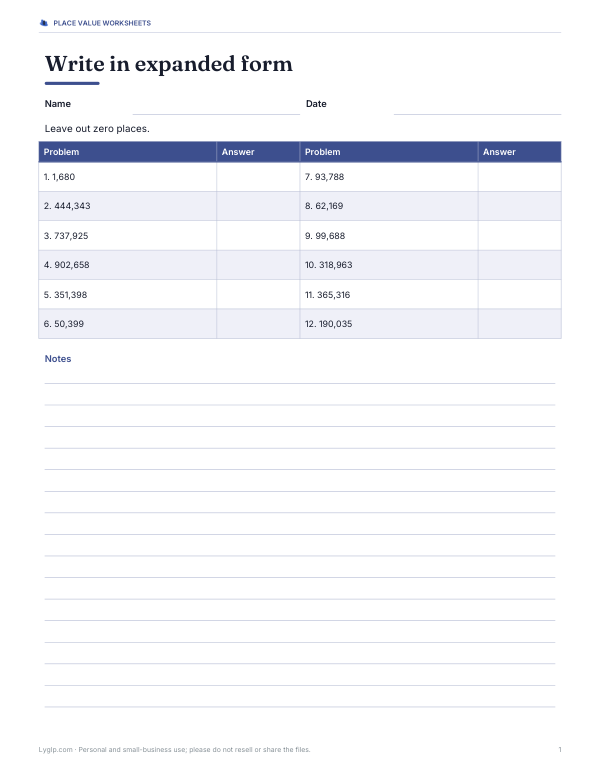
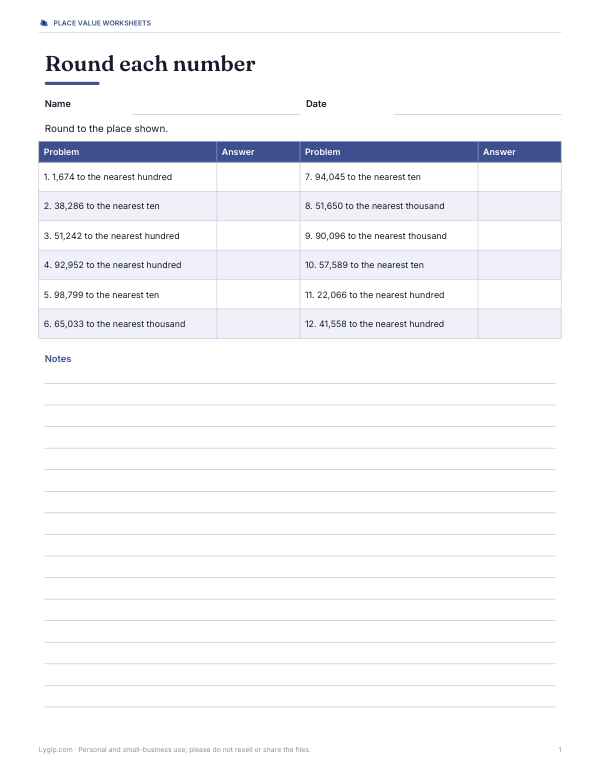
Place value chart
Place Value Worksheets
Printable place value resources with answer keys: a blank place value chart, expanded form worksheets, a rounding practice set and digit cards.
- Blank chart (PDF)
- Expanded form (PDF, DOCX)
- Rounding practice (PDF, DOCX)
- Digit cards (PDF)
Formats: PDF, DOCX. Instant download after payment (link valid 72 hours, up to 5 downloads). AI-assisted: the templates were drafted with AI help and reviewed and laid out before publishing.
$3.00 USD, one-time 4 files · about $0.75 each
- Instant download
- 7-day refund
- Secure checkout by Stripe
7-day money-back guarantee. Full refund within 7 days of purchase, even after you download.
Free sample: Blank Place Value Chart (PDF, 63 KB)
Full refund within 7 days — see the refund policy and license.
Free printables
Single sheets you can print right now, no sign-up. The full pack adds every sheet in one download plus the editable files.
 Printable Digit Cards PDF
What is place value?
Our number system is a base-ten, place value system: each position is worth ten times the position to its right. Reading from right to left, whole-number places are ones, tens, hundreds, thousands and so on; after the decimal point come tenths, hundredths and thousandths. The same digit means different amounts in different places — in 555, the three fives are worth 500, 50 and 5.
The place value chart
| Place | Value | Example digit 7 |
|---|---|---|
| Millions | 1,000,000 | 7,000,000 |
| Hundred thousands | 100,000 | 700,000 |
| Ten thousands | 10,000 | 70,000 |
| Thousands | 1,000 | 7,000 |
| Hundreds | 100 | 700 |
| Tens | 10 | 70 |
| Ones | 1 | 7 |
| Tenths | 0.1 | 0.7 |
| Hundredths | 0.01 | 0.07 |
| Thousandths | 0.001 | 0.007 |
Commas separate groups of three digits (periods) in whole numbers: ones, thousands, millions, billions. In many countries a space or full stop is used instead.
Standard, expanded and word form
| Form | Example for 3,406,258.72 |
|---|---|
| Standard form | 3,406,258.72 |
| Expanded form | 3,000,000 + 400,000 + 6,000 + 200 + 50 + 8 + 0.7 + 0.02 |
| Word form | three million, four hundred and six thousand, two hundred and fifty-eight and seventy-two hundredths |
Zeros are left out of expanded form — here there are no ten-thousands — but they still hold their place in standard form. In the US, “and” is often reserved for the decimal point: three million, four hundred six thousand…
How to use the chart
- Type any number, with or without commas, up to ten whole-number digits and three decimal places.
- Read each digit in its column and its value underneath.
- See the expanded form and the number written in words.
- Choose a place to round to and see the rounded number.
- Press “Practice question” for a quick question with a hidden answer.
Rounding with place value
- Find the place you are rounding to.
- Look at the digit immediately to its right.
- If that digit is 5 or more, round up; if 4 or less, keep the digit.
- Replace all digits to the right with zeros (or drop them after the decimal point).
Example: 3,406,258.72 rounded to the nearest thousand looks at the hundreds digit, 2, so it rounds down to 3,406,000; rounded to the nearest tenth it looks at the hundredths digit, 2, and becomes 3,406,258.7.
Worked example
A class looks at 3,406,258.72. The chart shows 3 in the millions place (worth 3,000,000), 4 in the hundred thousands (400,000), 0 in the ten thousands, 6 in the thousands (6,000), 2 in the hundreds, 5 in the tens, 8 in the ones, 7 in the tenths (0.7) and 2 in the hundredths (0.02). Rounded to the nearest ten thousand it is 3,410,000, because the thousands digit 6 is 5 or more.
Comparing and ordering numbers
To compare two numbers, line them up by place value. A whole number with more digits is larger; if they have the same number of digits, compare from the left until the digits differ. With decimals, line up the decimal points and add zeros if it helps: 0.45 and 0.405 become 0.450 and 0.405, so 0.45 is larger. A common mistake is thinking a longer decimal is bigger — 0.405 has more digits but is smaller.
Place value around the world
The idea that a digit’s position sets its value, with a zero to hold empty places, developed in India and spread through the Arabic-speaking world to Europe. Before that, systems such as Roman numerals had no place value — MMXXVI needs many symbols to show 2026. Place value is what makes written arithmetic like column addition and long multiplication possible.
Place value and multiplying by 10
Multiplying by 10 moves every digit one place to the left, so each digit becomes worth ten times as much: 3.7 × 10 = 37. Dividing by 10 moves digits one place to the right: 37 ÷ 10 = 3.7. Multiplying by 100 or 1,000 moves digits two or three places. Thinking of digits moving — rather than the decimal point jumping — helps children understand why the rule works.
Teaching tips
- Use base-ten blocks or money (coins and notes) to show that ten of one place make one of the next.
- Say numbers in parts: “three million, four hundred six thousand…”.
- Compare numbers by lining up place values from the left.
- Link decimals to money: tenths are dimes, hundredths are cents.
- Practise with digit cards: make the largest and smallest number from the same digits.
Privacy
The chart works in your browser; nothing you type is stored.
Frequently asked questions
What is place value?
The value a digit has because of its position in a number.
What is the value of 5 in 3,452?
50, because it is in the tens place.
What comes after thousandths?
Ten-thousandths, then hundred-thousandths.
What is expanded form?
A number written as the sum of each digit’s value, such as 300 + 40 + 2.
How do you round to the nearest hundred?
Look at the tens digit: 5 or more rounds up.
Can I print a blank place value chart?
Yes, it is in the printable pack.
Why do zeros matter in a number?
A zero holds a place, so 405 and 45 are different numbers.
What is the value of 7 in 0.07?
Seven hundredths, because it is in the hundredths place.